History Thread (Pre WWI)

JawboneOfAnAss

Well-known member
A side effect of recent events with the War thread made me thinking about having a thread about interesting stories from history. Famous battles, inventions, crazy monarchs and scheming nobles, real life basis for forklore, stuff like that. The kind of stories that make people say 'Damn that's interesting'. I am suggesting keeping it to prior to WWI to reduce discussions devolving into debates about who owns which part of former Yugoslavia or the like and keeping things light.

I'll start. The battle of Alesia. The final stand of Vercingetorix of the Gallic alliance against Julius Caesar. A loss here, and all of Gaul becomes Roman clay. The Gallic army has reinforcements surround the sieging Romans. So what does Caesar do? Build another wall!


(Yes, I literally just copied the older junkies thread).
 
A side effect of recent events with the War thread made me thinking about having a thread about interesting stories from history. Famous battles, inventions, crazy monarchs and scheming nobles, real life basis for forklore, stuff like that. The kind of stories that make people say 'Damn that's interesting'. I am suggesting keeping it to prior to WWI to reduce discussions devolving into debates about who owns which part of former Yugoslavia or the like and keeping things light.

I'll start. The battle of Alesia. The final stand of Vercingetorix of the Gallic alliance against Julius Caesar. A loss here, and all of Gaul becomes Roman clay. The Gallic army has reinforcements surround the sieging Romans. So what does Caesar do? Build another wall!


(Yes, I literally just copied the older junkies thread).
Nice videos by this guy
 
Want to do a quick bit on the Mithridatic Wars. So, during the later Roman Republican era, after all of Alexander the Great's successor kingdoms (except Egypt, but they were on the way there anyway) have been either dismantled or had the Roman boot on their heads (except for Baktria but Rome wasn't going to reach Afghanistan so they don't matter), one last Greek King stood in their way for conquest of the Greek world. Mithradates the VI. The Poison King. The man who microdosed poison to build immunity. The man who committed one of the first recorded genocides for the sake of the genocides in western history, when he instigated a mass Greek revolt that massacred as many Romans in Anatolia as possible to reverse the Roman footprint in the Greek world. This sparked three successive wars, arguably spawning the continent if you count Sertorius' war in Spain being a partial byproduct of this conflict. I got two coins representing this conflict. First, a tetrobol minted in Phanagoriya (near modern day Krasnodar Russia, back then the Bosporan client kingdom (modern day Crimea and the part of Russia to the right of the peninsula) of the Pontic Empire ruled by Mithradates VIs, and later given to his eldest son Machares who will be important later on.

mithradates front.jpgmithradates back.jpg

(I used an AI tool to remove some of the background, coin itself is unaltered, that's why the coin holder looks weird). Tetrobol, worth four obols, or 2/3 of a drachm (consider drachm the $20 bill of the ancient Greek world). Made of silver, obverse shows Artemis, the patron deity of the Bosporan Kingdom. Reverse, the text is kinda cut off (not unusual for hammered coins with long legends) but the top says in Greek 'PHANAGO' and the bottom under the rose says 'RIYA'.

https://en.numista.com/411923 (How the fuck did someone pay $600 for this? Are they insane? I got mine for $150 lol).

During all this, a powerful kingdom reached a peak under the cultures most illustrious king. Tigranes the Great of Armenia. Of the House of Artaxiad. A house that traces its bloodline to one of the seven nobles that put Darius the Great on the Achaemenid throne. Tigranes was also the son-in-law of Mithradates the VI and would eventually be dragged into war with Rome when Counsel and future Triumphetor Lucius Licinius Lucullus, one of the most underrated Roman commanders, comes knocking on the door demanding the Poison King's handover.

20260512_200024.jpg

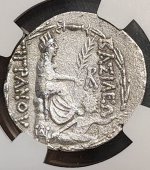
Can only attach 3 files so will attach the reverse on the next post. Minted in the lost city of Tigranokerta, the imperial capital at the time, an Athens of the Caucasus. Tetradrachm, worth 4 drachm, equivalent to a weeks pay for a Greek soldier. Basically the $100 of the ancient world. This could pay for groceries for a family of four for two weeks. Armenia, like many other non-Roman kingdoms of the region, adopted Greek currency types and used Greek on their coinage, as Greek was the language of trade at the time, as English, Spanish, Arabic, and Mandarin might be today. I love the diadem on Tigranes' head. If anyone played Rome Total War 2, that is indeed the faction logo, two birds facing away from a star, the royal crest of the Artaxiad House. And yes, that's the man himself. That's his actual portrait.

Well anyway: the video itself, from Kings and Generals. The conclusion of the Mithradatic Wars. Lucullus shows tactical brilliance only to lose command due to a mutiny over things out of his control, leading to the GOAT of credit-stealing Gnaus Pompey Magnus taking command and hotdogging and grandstanding all over the Black Sea. Lucullus eventually does get his triumph at the end, and instead of going the Pompey and Caesar route of trying to dominate politics, takes his massive haul of treasure and slaves to build several insanely opulent villas where he eats, drinks, and fucks until he goes senile. Lucullus also brought sour cherries and apricots to the Roman diet and was described by Pompey as 'Xerxes in a toga'.

Wikipedia citing a passage from the Roman historian Plutarch:

On another occasion, the tale runs that his steward, hearing that he would have no guests for dinner, served only one not especially impressive course. Lucullus reprimanded him saying, "What, did not you know, then, that today Lucullus dines with Lucullus?"

Oh, and Pharnaces, near the end of the video? He later faces Julius Caesar in a rematch of the Battle of Zela. And gets absolutely obliterated. It's where Caesar coined the phrase 'Veni, Vidi, Vici'. 'I came, I saw, I conquered'.
 
And now the reverse,

20260512_200040 (2).jpg
The goddess Tyche holding a palm branch, standing on the river god araxes. Written in Greek the legend, on the right, 'BASILEUS (KING)' on the left 'TIGRANOI (TIGRANES)'. Two monograms, special marks popularized by Greek coin making. The bottom left under Tyche's tuchus has a crown monogram (Delta H, not sure what it stands for) while to the right of the palm branch is an AR (Armenia? Artaxiad?)


Oh, and if anyone is wondering, this is not worth $1K. A lot of idiots got into this hobby during Covid like with Pokemon cards and spent like crazy with no regard for established market value, spiking prices for a couple of years before it crashed. I got in when things finally calmed down.

As for Armenia, this was the high water mark for the Armenian civilization. After Mithradates' suicide, Armenia became a client kingdom for Rome, and spent the next 700 years being a geopolitical football for the Romans and the two successive Persian empires (Parthia and the Sassanians). Aside from a successful three hundred year long crusader state of Cilician Armenia, this was the last long lasting independent Armenian state until the Soviet Union collapsed.
 
Last edited:
The Battle of Cannae - 216 B.C

During the Second Punic War, Hannibal had already achieved the impossible by invading Italy over the Alps with a mercenary army and large company of war elephants. Next, he stunned the Mediterranean world by soundly defeating Roman Legions in two large battles on Italian soil. Now, Rome had amassed the largest army they had ever fielded in order to decisively crush Hannibal once and for all. Estimates have varied over the centuries, but there were no less than 80,000 infantry, and more than 6000 horse. This would be at least 16 legions, and was an absolutely massive number of soldiers to field.

Hannibal is estimated to have fielded approximately 40,000 infantry, and 10,000 horse. While Hannibal was distinctly stronger in cavalry, he was, at face value, significantly weaker in force composition, with most of his army being a group of non-homogenous mercenaries, including a great number of unruly and undisciplined Gauls fighting to spite Rome, not in favor of Carthaginian rule.

Hannibal was to use his enemy’s strength against them, and would turn his weakness into an asset. He positioned his Gauls in a convex formation in his center, a rather unconventional arrangement. He positioned his light horse on his right flank, and his heavy horse on his left flank. He positioned his heaviest and most reliable African heavy infantry further off on the wings in inconspicuous positions, and they did not initially engage the Romans who took no notice of them.

Hannibal, as usual, led from the center and fought side by side with his men, which was also his intentionally weakest point. After the skirmishers completed their stage of the battle and retired inconclusively, the Roman heavy infantry, the historical legionnaires, who were arranged in an unusually deep formation to accommodate their massive numbers, advanced confidently at the apparently weak Carthaginian center. As soon as the forces engaged, Hannibal led an incredibly difficult maneuver: an organized retreat while still fighting the Romans. This was planned, and slowly turned the convex into a concave, with the weight of the Roman Legions steadily pushing their way forward.

Meanwhile, the Carthaginian cavalry had steadily driven their counterparts from the battlefield, soundly winning their respective engagements. One of the Roman commanders, Paulus, was gravely wounded, but rode back to his still considerable formation of heavy infantry and led from the center there. The Gauls and other assorted light infantry continued to steadily fight backwards, with Hannibal controlling the entire battle from the center.

At this point, three things happened: the veteran heavy African infantry now moved into battle and advanced on both Roman flanks; the two groups of Carthaginian cavalry wheeled around and began to hit the Roman rear; and, as was planned by Hannibal, the afternoon sun came into perfect position to obscure the enemy infantry’s vision. A perfect symphony was just reaching its crescendo, perfectly orchestrated and executed by one of the finest military leaders in the history of the world. The most historically incredible example of double envelopment with a pincer movement was unfolding right now, much to the dismay of close to 100,000 Roman souls who now had nowhere to retreat.

The Carthaginians killed almost every one of them in what is still to this day one of the most massive slaughters of human life in one battle in the history of our species. Hannibal turned his superficially weaker, and significantly numerically smaller, force into a fearsome weapon, using even the well timed sun against his foes. Hannibal had many, many impressive victories in his undefeated time on Italian soil, but Cannae was his magnum opus without doubt. He made the plan, executed the plan from the most difficult position, and decisively defeated his stronger foe. This was also one of the few times in history a numerically weaker force performed a successful double envelopment of a stronger force.

The Battle of Cannae was nothing short of tactical brilliance and genius leadership by one of the finest military minds to have ever been born. And he also did the heavy lifting.

1280px-Battle_of_Cannae%2C_215_BC_-_Initial_Roman_attack.svg.png

1280px-Battle_cannae_destruction.svg.png

 
The Battle of Cannae - 216 B.C

During the Second Punic War, Hannibal had already achieved the impossible by invading Italy over the Alps with a mercenary army and large company of war elephants. Next, he stunned the Mediterranean world by soundly defeating Roman Legions in two large battles on Italian soil. Now, Rome had amassed the largest army they had ever fielded in order to decisively crush Hannibal once and for all. Estimates have varied over the centuries, but there were no less than 80,000 infantry, and more than 6000 horse. This would be at least 16 legions, and was an absolutely massive number of soldiers to field.

Hannibal is estimated to have fielded approximately 40,000 infantry, and 10,000 horse. While Hannibal was distinctly stronger in cavalry, he was, at face value, significantly weaker in force composition, with most of his army being a group of non-homogenous mercenaries, including a great number of unruly and undisciplined Gauls fighting to spite Rome, not in favor of Carthaginian rule.

Hannibal was to use his enemy’s strength against them, and would turn his weakness into an asset. He positioned his Gauls in a convex formation in his center, a rather unconventional arrangement. He positioned his light horse on his right flank, and his heavy horse on his left flank. He positioned his heaviest and most reliable African heavy infantry further off on the wings in inconspicuous positions, and they did not initially engage the Romans who took no notice of them.

Hannibal, as usual, led from the center and fought side by side with his men, which was also his intentionally weakest point. After the skirmishers completed their stage of the battle and retired inconclusively, the Roman heavy infantry, the historical legionnaires, who were arranged in an unusually deep formation to accommodate their massive numbers, advanced confidently at the apparently weak Carthaginian center. As soon as the forces engaged, Hannibal led an incredibly difficult maneuver: an organized retreat while still fighting the Romans. This was planned, and slowly turned the convex into a concave, with the weight of the Roman Legions steadily pushing their way forward.

Meanwhile, the Carthaginian cavalry had steadily driven their counterparts from the battlefield, soundly winning their respective engagements. One of the Roman commanders, Paulus, was gravely wounded, but rode back to his still considerable formation of heavy infantry and led from the center there. The Gauls and other assorted light infantry continued to steadily fight backwards, with Hannibal controlling the entire battle from the center.

At this point, three things happened: the veteran heavy African infantry now moved into battle and advanced on both Roman flanks; the two groups of Carthaginian cavalry wheeled around and began to hit the Roman rear; and, as was planned by Hannibal, the afternoon sun came into perfect position to obscure the enemy infantry’s vision. A perfect symphony was just reaching its crescendo, perfectly orchestrated and executed by one of the finest military leaders in the history of the world. The most historically incredible example of double envelopment with a pincer movement was unfolding right now, much to the dismay of close to 100,000 Roman souls who now had nowhere to retreat.

The Carthaginians killed almost every one of them in what is still to this day one of the most massive slaughters of human life in one battle in the history of our species. Hannibal turned his superficially weaker, and significantly numerically smaller, force into a fearsome weapon, using even the well timed sun against his foes. Hannibal had many, many impressive victories in his undefeated time on Italian soil, but Cannae was his magnum opus without doubt. He made the plan, executed the plan from the most difficult position, and decisively defeated his stronger foe. This was also one of the few times in history a numerically weaker force performed a successful double envelopment of a stronger force.

The Battle of Cannae was nothing short of tactical brilliance and genius leadership by one of the finest military minds to have ever been born. And he also did the heavy lifting.

1280px-Battle_of_Cannae%2C_215_BC_-_Initial_Roman_attack.svg.png

1280px-Battle_cannae_destruction.svg.png

You know you are clever when your greatest victory is cited in military academies 2200 years into the future, when sword fighting has already been rendered obsolete.
 
Back
Top